
 Egypt
Heading to the Valley of the Kings? The Valley of the Kings contains 63 royal tombs of New Kingdom pharaohs near Luxor, including Tutankhamun (KV62), Ramesses II (KV7) and Seti I (KV17), with original 3,200-year-old painted walls. This guide covers what it costs, opening hours, the best months to go, how to get there and practical tips.
At a glance
- Entry
- EGP 300 (3 tombs) · Tutankhamun +EGP 300
- Opening hours
- 8 AM – 4 PM (summer) · 8 AM – 5 PM (winter)
- Best time
- November to March
- Location
- West Bank, Luxor, Upper Egypt
What to expect at the Valley of the Kings
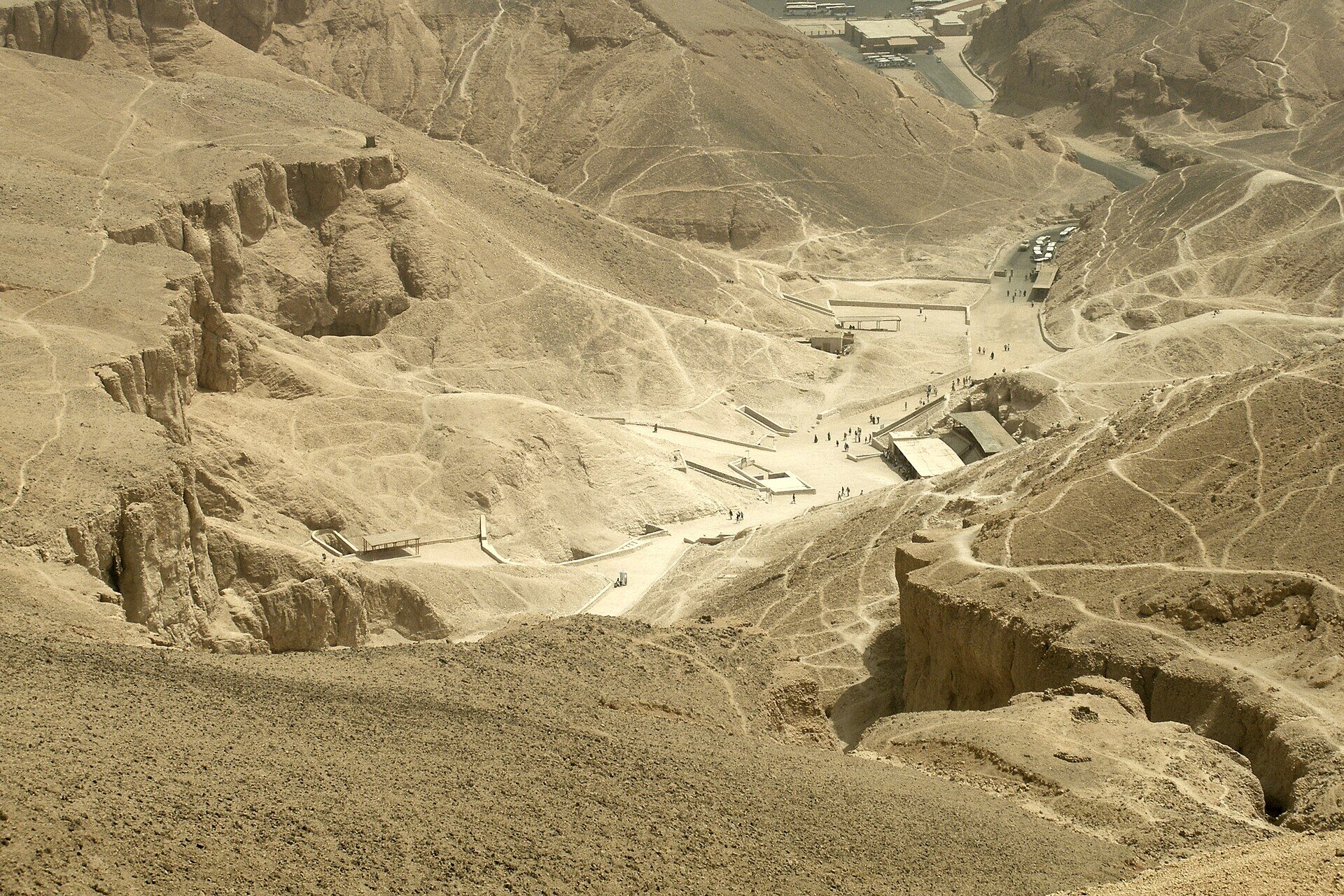
The Valley of the Kings (Wadi el-Muluk) is the most significant royal necropolis of the ancient world, a dry limestone valley on the west bank of the Nile at Luxor where the pharaohs of Egypt's New Kingdom (about 1550–1070 BC) cut their tombs into the cliff faces in an attempt to conceal and protect the royal burials after the pyramids of the Old and Middle Kingdoms had proven vulnerable to robbers.
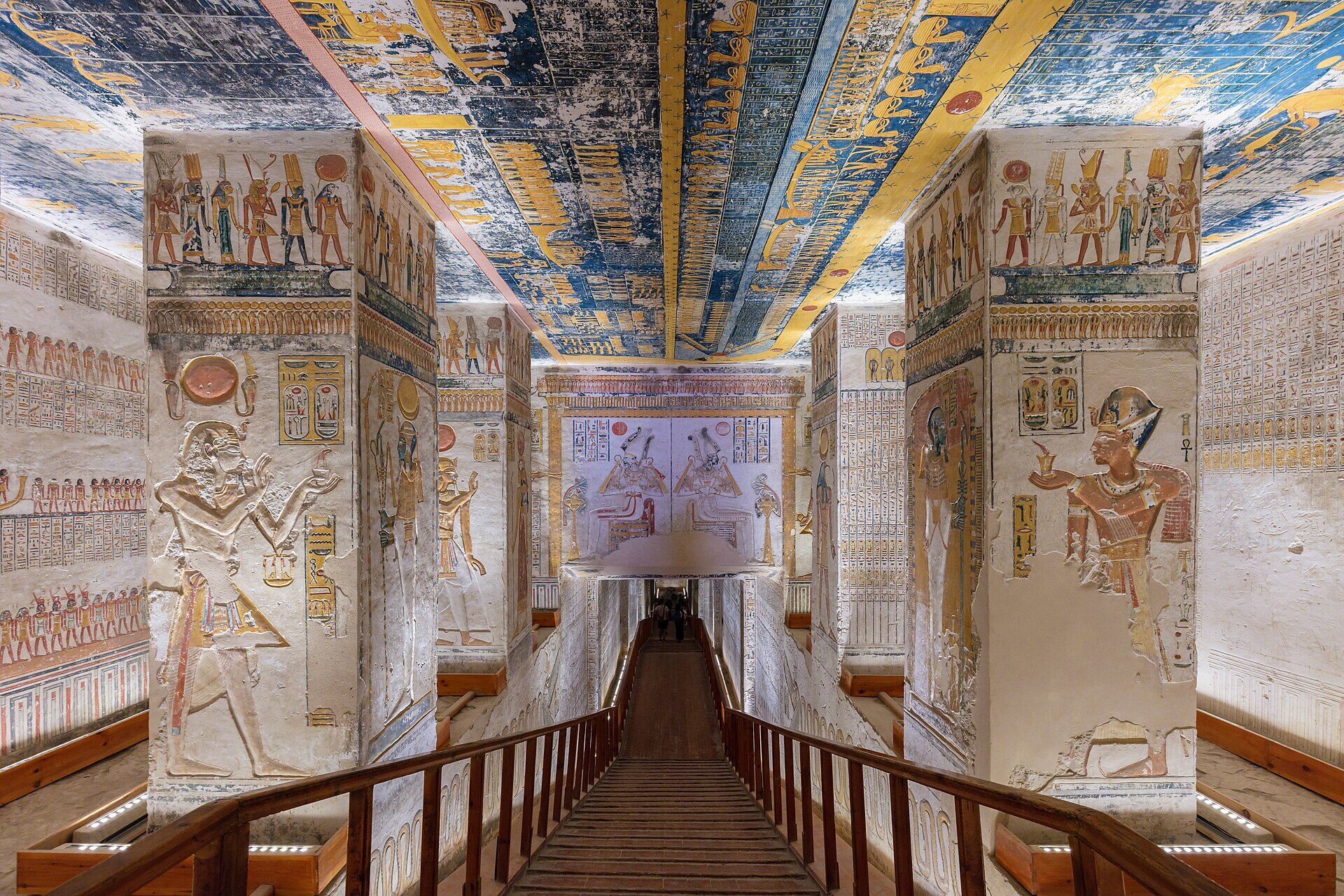
Over a period of about 500 years, 64 tombs were cut into the Valley of the Kings (with additional tombs in the associated Valley of the Queens and the workers' village of Deir el-Medina), their walls decorated with the religious texts of the Books of the Dead, the Amduat (Book of the Underworld) and other funerary literature in paintings of striking quality that preserve the finest examples of New Kingdom artistic achievement currently accessible to visitors.

Tomb of Tutankhamun
The tomb of Tutankhamun (KV62, additional entry about EGP 300 above the valley ticket) is the Valley's most famous tomb and the smallest of the royal tombs, its fame derives entirely from the striking intact burial assemblage discovered by Howard Carter on November 4, 1922, which revealed the complete contents of an unlooted royal tomb for the first time. The tomb itself is not particularly impressive artistically (the paintings are relatively crude compared to the great 19th and 20th Dynasty tombs) but the burial chamber, where the outermost gilded coffin remains in the sarcophagus, with Tutankhamun's mummy inside.
Also, the antechamber and treasury are deeply evocative of the discovery moment. The golden mask, coffins and about 5,000 objects from the tomb are in the Egyptian Museum (Cairo) and the new Grand Egyptian Museum (Giza, opened 2023).
Finest decorated tombs
Also, the best decorated tombs in the Valley are those of the 19th and 20th Dynasties (about 1292–1069 BC): the tomb of Seti I (KV17, currently closed for conservation), whose paintings of the complete Book of Gates in preserved vivid colours are the finest surviving New Kingdom royal tomb paintings. The tomb of Ramesses III (KV11, typically open), with its unusual side chambers decorated with painted reliefs of the pharaoh's earthly pleasures including musical instruments, food and captive peoples.
And the tomb of Ramesses VI (KV9, typically open), whose astronomical ceiling, the longest preserved ancient Egyptian astronomical ceiling painting, depicting the complete Book of the Day and Book of the Night with the sun's journey through the heavens, is among the most impressive single painted ceilings in the ancient world.
Standard valley ticket
The standard valley ticket (about EGP 200–240) includes entry to three tombs from a rotating selection. Specific tombs (Tutankhamun, Ay, Ramesses V/VI) require additional tickets. Photography inside the tombs is prohibited (strictly enforced since 2010, cameras are checked at the ticket office entrance). The best strategy for a valley visit is to arrive at opening (6 AM) when the tombs are cool and un-crowded, and to ask at the ticket office which tombs are currently open and in good condition before selecting.
Workers' village of Deir el-Medina
Besides, the workers' village of Deir el-Medina, 2km south of the Valley of the Kings on the road to the Valley of the Queens, is the essential complement to any Valley visit, a completely excavated walled village where the artisans and painters who cut and decorated the royal tombs lived for about 450 years. In fact, the village is the most completely documented ancient settlement in Egypt (the villagers were literate and left thousands of ostraca, pottery sherds and limestone flakes used as writing material, recording their daily life, disputes, love letters.
Also, complaints about late wages) and gives the closest available glimpse of ordinary life in New Kingdom Egypt. The workers' own tombs, cut into the cliff above the village and decorated with paintings of exceptional quality at their private expense, are accessible with the standard Deir el-Medina ticket (about EGP 100).
Colossi of Memnon
The Colossi of Memnon, two 18-metre seated statues of Amenhotep III standing in the Nile flood plain at the entrance to the Theban necropolis (free, visible from the road), are the standard first or last sight of the west bank visit, gigantic remnants of what was once the largest temple complex in Egypt, long since destroyed and the stone reused for other construction. Besides, the colossi are free to visit and are accessible independently of the valley tickets. This makes them a worthwhile stop when entering or leaving the west bank.
Valley of the Kings tickets and prices
Here is what a visit to the Valley of the Kings costs. Prices are per person unless noted. Because they change with the season, treat them as a guide.
| Ticket or service | Price |
|---|---|
| Valley of the Kings entry (3 standard tombs) (Choose from open rotation · Not Tutankhamun or Seti I) | EGP 300 |
| Tutankhamun's tomb (KV62) — separate (Most famous · Small interior · Mummy in situ) | EGP 300 extra |
| Seti I (KV17) — special ticket (Finest decoration in valley · 137m long) | EGP 1,000 extra |
| Ticket or service | Price |
|---|---|
| Egyptian nationals (Significant discount with Egyptian ID) | EGP 30 |
| Ticket or service | Price |
|---|---|
| Hatshepsut Temple (Deir el-Bahari) (15 min from Valley · Finest mortuary temple in Egypt) | EGP 260 |
| Colossi of Memnon (Free · 18m seated pharaoh statues · On route to Valley) | Free |
| Licensed Egyptologist guide (West Bank full day) (Valley + Hatshepsut + Ramesseum) | USD 50–100 |
ℹ Prices in Egyptian Pound (EGP) . Confirm rates before visiting.
How to get to the Valley of the Kings
These are the easiest ways to reach the Valley of the Kings, with typical costs and times.
Local ferry from Luxor east bank + taxi
Ferry from Luxor (near the temple) to West Bank. Then shared or private taxi 8km to the Valley.
Organised West Bank tour from hotel
Most Luxor hotels offer West Bank day trips: Valley + Hatshepsut Temple + Colossi of Memnon.
Bicycle from West Bank ferry landing
Flat riverside then uphill to Valley. Good for the return circuit via Ramesseum.
Best time to visit the Valley of the Kings
The best time to visit the Valley of the Kings is November to March. April to May and September to October also work well if your dates are fixed.
- Jan
- Feb
- Mar
- Apr
- May
- Jun
- Jul
- Aug
- Sep
- Oct
- Nov
- Dec
BestGoodFairAvoid
(Oct–Apr: 15–28°C) · Good (May, Sep) · OK (Jun–Aug: 40°C+ in the valley, no shade)
Tips for visiting the Valley of the Kings
These tips make a visit to the Valley of the Kings easier, especially if it is your first time.
First Entry at 8 AM for Empty Tombs
Tour buses arrive after 9:30 AM. In fact, the 90-minute window at opening gives near-complete silence in the decorated tombs, the most immersive experience possible.
Do Not Skip Hatshepsut Temple
Deir el-Bahari (EGP 260, 15 min away) is one of the best New Kingdom monuments in Egypt. Any West Bank day should combine both.
Bring a Torch for Ceiling Details
The astronomical ceilings and upper registers are difficult to see in the available light. Generally, a small torch reveals striking hieroglyphic and figurative detail invisible to the naked eye.
No Shade in the Valley — Bring Water
The Valley is a deep limestone canyon. Moreover, in summer it exceeds 40°C with no natural shade. Carry 2 litres minimum. Also, the tomb interiors (20–22°C) provide welcome cooling.
An Egyptologist Guide Is Transformative
In addition, the religious texts covering every surface require expert interpretation. In addition, a licensed Egyptologist who can explain the Amduat hour-by-hour transforms the visit entirely.
Colossi of Memnon Are Free and Impressive
The 18-metre seated statues of Amenhotep III (on the road to the Valley) are free to visit and photograph. Allow 20 minutes, the scale is striking up close.
Where to stay near the Valley of the Kings
If you want to stay close to the Valley of the Kings, start with these hotels. Rates are rough nightly guides, so check before you book.
Marriott Mena House (Giza) ★★★★★
USD 200–500/nightGiza Plateau, Pyramid views
The best hotel position in Egypt, within the Giza Plateau compound with Pyramid views from pool and rooms. Historic 1869 palace.
Sofitel Legend Old Cataract (Aswan) ★★★★★
USD 250–600/nightAswan, Nile and Elephantine views
One of Africa's great historic hotels, Agatha Christie wrote here, the terrace overlooks the Nile. Striking atmosphere.
Steigenberger Nile Palace (Luxor) ★★★★★
USD 100–200/nightLuxor, Nile frontage
Best Luxor hotel with Nile pool views. Central for Luxor and Karnak temples.
Nefertiti Hotel (Luxor) ★★★
USD 25–60/nightLuxor city centre
Best value in Luxor, clean rooms, good breakfast and rooftop with Luxor Temple view.
Arabian Nights Hotel (Cairo) ★★★
USD 30–70/nightCairo near Egyptian Museum
Reliable budget option in central Cairo near the Egyptian Museum and Tahrir Square.
Valley of the Kings: frequently asked questions
How much does the Valley of the Kings cost?
Standard entry EGP 300 (3 tombs from the general rotation). Tutankhamun's tomb (KV62) separate ticket EGP 300 extra. Seti I (KV17, the most elaborate) EGP 1,000 extra.
Which tombs should I visit?
Ramesses IV (KV2), largest, least claustrophobic. Merenptah (KV8), large, well-preserved. Ramesses IX (KV6), excellent astronomical ceiling. Tutankhamun (KV62), famous but small. Seti I (KV17), best decoration if budget allows.
How long does a visit take?
3 standard tombs: 1.5–2 hours. 5 tombs including Tutankhamun: 2.5–3 hours. Combine with Hatshepsut Temple (15 min away) and Colossi of Memnon for a full West Bank day.
Can I take photographs?
Photography has been prohibited since 2020 to protect the painted walls. Enforcement varies by tomb.
What are the opening hours of the Valley of the Kings?
Valley of the Kings is open 8 AM – 4 PM (summer) · 8 AM – 5 PM (winter). Hours can change during Ramadan and public holidays, so check before you travel.
When is the best time to visit the Valley of the Kings?
The best time to visit the Valley of the Kings is November to March. April to May and September to October also work well if your dates are fixed.
Updated October 2026. Prices and opening hours change, so check the official website or the official Egypt tourism site before you travel. Spotted a mistake? Tell us and we will fix it.
Photos: Diego Delso / CC BY-SA 4.0 via Wikimedia Commons; Diego Delso / CC BY-SA 4.0 via Wikimedia Commons; Diego Delso / CC BY-SA 4.0 via Wikimedia Commons; Vyacheslav Argenberg / CC BY 4.0 via Wikimedia Commons.