
 Spain
Planning a visit to Toledo in Spain? Toledo is a medieval city on a granite hilltop above the Tagus River in Castile-La Mancha, Spain, the former capital of the Visigothic Kingdom and Christian Spain, containing one of Europe's best Gothic cathedrals and a remarkable mixture of Jewish, Muslim and Christian heritage. UNESCO World Heritage Site. This guide covers what it costs, the best months to go, how to get there and practical tips.
At a glance
- Entry
- €10 (Toledo Cathedral entry)
- Time needed
- Full day recommended · Start early
- Best time
- April to May and September to October
- Location
- Toledo, Castile-La Mancha, 70km from Madrid
What to expect at Toledo
Toledo was the capital of Visigothic Spain, then the cultural centre of Islamic Al-Andalus for three centuries, then the capital of Castile and subsequently of the unified Spanish kingdom under the Catholic Monarchs and the early Habsburgs, a city where Christians, Muslims and Jews lived in complex coexistence for centuries and whose unique concentration of architecture, art and cultural history across three great medieval civilisations earned it UNESCO World Heritage designation in 1986 as an 'remarkable monument to three cultures.' The city occupies a promontory almost entirely surrounded by the deep gorge of the Tagus River, its medieval fabric, cathedral, synagogues, mosques, churches, palaces and convents, compressed within the original walls on a rocky peninsula that made Toledo almost impregnable for centuries.


Toledo Cathedral
The Toledo Cathedral is one of the greatest Gothic cathedrals in Europe, a building begun in 1226 on the site of the main mosque of the city's Islamic period, completed over two and a half centuries in a style that progresses from French Gothic at the east end to the late Gothic Plateresque of the west facade, and containing an interior of remarkable richness: the Mozarabic chapel (where the ancient pre-Roman rite of the Iberian Church is still celebrated), the Transparent (a baroque altarpiece of extreme decorative ambition that pierces the cathedral wall to create a theatrical lighting effect), the sacristy containing an incomparable collection of El Greco paintings, and the chapter house whose mudejar (Islamic-influenced Christian) ceiling is the top in Spain.
El Greco
El Greco (Domenikos Theotokopoulos, 1541–1614) chose Toledo as his permanent home after arriving from his native Crete via Venice and Rome, and his paintings, with their characteristic elongated figures, dramatic lighting and spiritual intensity, are so identified with the city that a visit to Toledo is effectively a pilgrimage to the greatest concentration of El Greco works outside a single building. The Museo del Greco (in a house adjacent to his original studio), the Santo Tomé Church (containing 'The Burial of the Count of Orgaz', his largest and most celebrated painting), the cathedral sacristy and the Museo de Santa Cruz together contain about 30 of his major works.
Jewish Quarter
In general, the Jewish Quarter (Judería) and its two medieval synagogues are among the top surviving monuments of Sephardic Jewish culture in Spain. Generally, the Sinagoga del Tránsito (14th century, now the Sephardic Museum) was built for the court physician to King Pedro I of Castile and contains the best example of mudejar decorative stonework in Toledo, the prayer hall's north wall covered in an intricate carved plaster screen of Hebrew inscriptions, arabesque patterns and heraldic shields that synthesises Islamic decorative technique with Jewish religious content in a single surface of remarkable sophistication. Also, the Sinagoga de Santa María la Blanca (12th century), with its forest of horseshoe arches, is the oldest synagogue building in Europe.
Museo de Santa Cruz
The Museo de Santa Cruz, housed in a 16th-century hospital of exceptional architectural quality (the plateresque facade is one of the most beautiful Renaissance doorways in Spain), contains the best assembly of Spanish medieval and Renaissance art outside Madrid, El Grecos, Flemish tapestries, Roman mosaics and Visigothic gold work in a building that is itself a masterpiece. Entry is free.
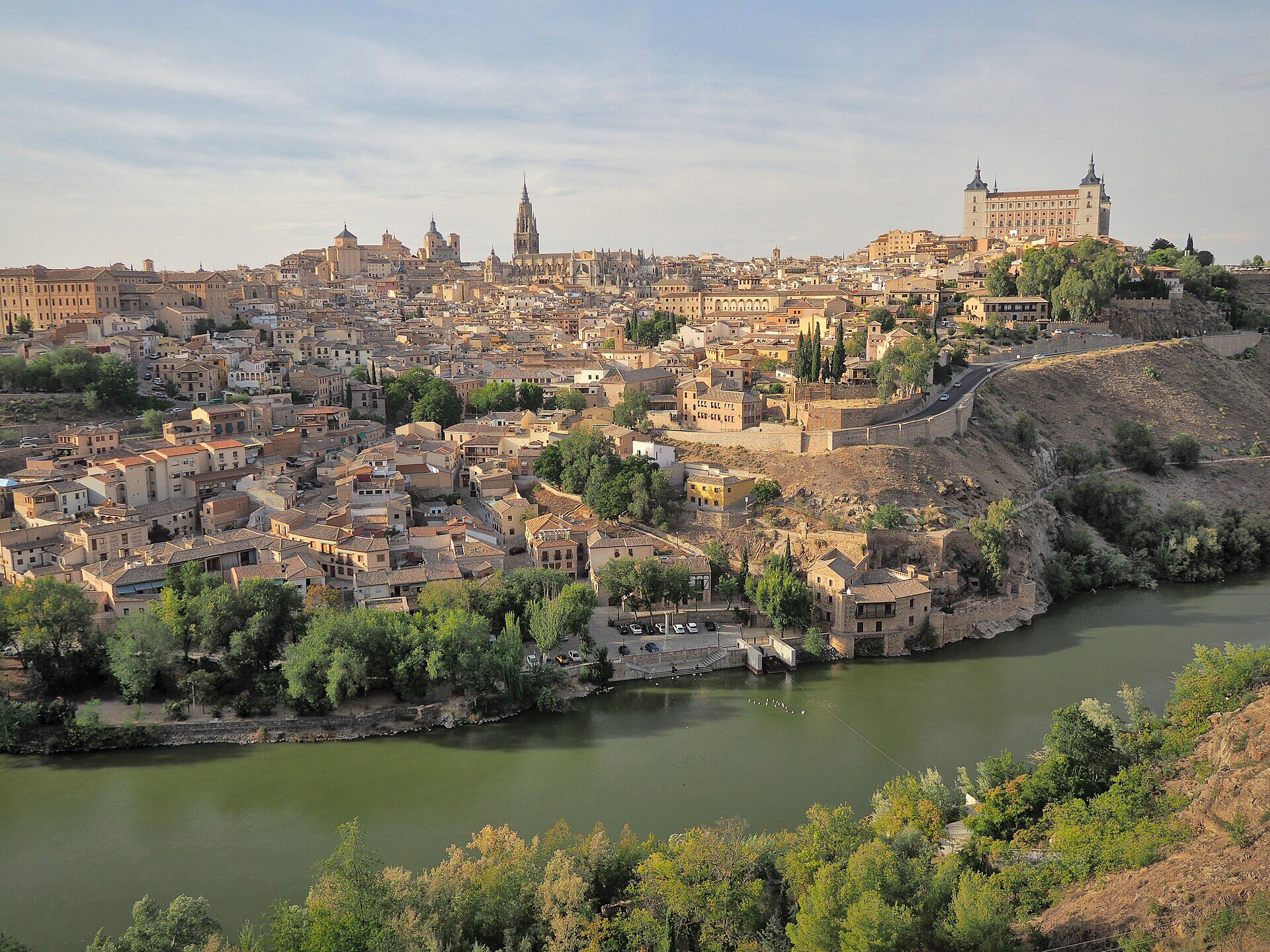
Toledo is an easy day trip from Madrid (Renfe high-speed trains take 33 minutes from Madrid-Atocha, about €13 each way, departing hourly). The most atmospheric approach is to take the first morning train (7:30–8:00 AM), spend the day exploring, and return on the late evening train after dinner. In fact, the best single evening in Toledo begins at the Parador de Toledo restaurant (the national hotel occupying the former Hospital de la Santa Cruz on the opposite bank of the Tagus) where the panoramic view of the city skyline across the gorge at sunset, cathedral spire, Alcazar palace, and the old walls reflected in the Tagus, gives the defining image of the city.
Toledo tickets and prices
Here is what a visit to Toledo in Spain costs. Prices are per person unless noted. Because they change with the season, treat them as a guide.
| Ticket or service | Price |
|---|---|
| Toledo Cathedral entry (Finest Gothic interior in Spain · Treasury · El Greco paintings) | €10 |
| Alcázar of Toledo (Fortress museum · Views · 16th century) | €5 |
| Sinagoga del Tránsito (14th century Mudéjar synagogue · Extraordinary plasterwork) | €3 |
| Ticket or service | Price |
|---|---|
| Cathedral (reduced Spanish ID) (Reduced rate with national ID) | €5 |
| Ticket or service | Price |
|---|---|
| El Greco Museum (Works by the Toledo master · Near the synagogues) | €3 |
| Marzipan (mazapán) tasting (Toledo's signature product · Multiple confectionery shops) | €5–20 |
| Traditional Toledo sword/knife purchase (Hand-made Damascus steel · Many workshops visible) | €30–500+ |
ℹ Prices in Euro (€) . Confirm rates before visiting.
How to get to Toledo
These are the easiest ways to reach Toledo in Spain, with typical costs and times.
AVE high-speed train from Madrid Atocha
The most practical option. High-speed trains from Madrid Atocha to Toledo every 30–60 minutes. Toledo station is 1km from the old town (taxi €5 or 20-min walk).
Bus from Madrid Estación Sur
ALSA buses from Madrid South Bus Station. Slightly slower but cheaper. Toledo bus station is adjacent to the Alcázar.
Drive from Madrid
Good motorway connection. Parking outside the city walls (free/cheap) then walk up through the Bisagra Gate. Driving inside the old city is not recommended.
Best time to visit Toledo
The best time to visit Toledo in Spain is April to May and September to October. March, June and November also work well if your dates are fixed.
- Jan
- Feb
- Mar
- Apr
- May
- Jun
- Jul
- Aug
- Sep
- Oct
- Nov
- Dec
BestGoodFairAvoid
(Mar–May, Sep–Oct: 20–28°C) · Good · OK (summer: 35–40°C in the old city)
Tips for visiting Toledo
These tips make a visit to Toledo in Spain easier, especially if it is your first time.
View from the Parador Terrace at Sunset
The Parador de Toledo hotel terrace (non-guests can sometimes access with a café purchase) on the south side of the Tagus River gives the most famous view of Toledo, the entire city silhouetted against the sunset sky. The same view from the road below (Carretera de Circunvalación) is free and equally fine.
Cathedral First — Allow 2 Hours
In general, the Toledo Cathedral deserves 2 full hours: the main nave, the Transparente (dramatic Baroque skylight altar), the treasury (a 16th-century monstrance of 18kg of gold), the sacristy with El Greco's Disrobing of Christ, Velázquez and Goya. Also, the best single interior in Castile.
Buy Marzipan at a Convent
Besides, the best Toledo marzipan is made by nuns in traditional convents and sold through a rotating window system (torno). Ring the bell, say what you want, and the marzipan appears through a turning wooden window. The best, Santo Domingo el Antiguo and San Clemente, is far better than tourist shop versions.
The Synagogues Show Toledo's Jewish Past
Two 14th-century synagogues survive in Toledo: the Sinagoga del Tránsito (€3, remarkable Mudéjar plasterwork) and the Sinagoga Santa María la Blanca (€2.80, Moorish horseshoe arches). Together they document one of medieval Europe's most significant Jewish communities before the 1492 expulsion.
Take the First AVE Train for a Full Day
The first AVE from Madrid Atocha to Toledo departs around 6:30 AM. Arriving in Toledo by 7 AM gives 30 minutes before the Cathedral opens, time to walk the empty streets and see the old city in morning light before day-trippers arrive on later trains.
Alcázar Views Over the Old City
The Alcázar fortress occupies the highest point in Toledo, the views from its exterior terraces over the surrounding Tagus river gorge and the Castilian plateau beyond are the best elevated views from inside the city walls.
Where to stay near Toledo
If you want to stay close to Toledo in Spain, start with these hotels. Rates are rough nightly guides, so check before you book.
Parador de Toledo ★★★★★
€180–300/nightSouth bank of Tagus, Best view of Toledo
The most famous hotel view in Castile, the Parador terrace across the Tagus from the entire Toledo skyline. Excellent restaurant and pool.
Hotel Santa Isabel de Toledo ★★★★
€80–160/nightOld city centre, near Cathedral
Charming hotel inside the historic city in a 15th-century building. Atmospheric stone interiors and excellent location for all monuments.
Hotel Alfonso VI ★★★★
€70–140/nightAdjacent to Alcázar
Classic Toledo hotel with good facilities adjacent to the Alcázar. Reliable four-star with comfortable rooms and breakfast included.
Albergue Juvenil Castillo San Servando ★★
€20–45/nightNear Toledo train station
Youth hostel in a 14th-century castle on the hill above the train station. Basic but atmospheric, sleeping in a medieval castle is good value.
Toledo: frequently asked questions
How much does it cost to visit Toledo in Spain?
Prices for Toledo in Spain start from €10 (Toledo Cathedral entry). Toledo Cathedral entry: €10; Alcázar of Toledo: €5; Sinagoga del Tránsito: €3. Also, booking online is usually cheaper than paying at the gate.
Can I visit Toledo as a day trip from Madrid?
Yes, Toledo is 70km from Madrid and served by high-speed AVE trains (30 minutes from Madrid Atocha, €12–15 each way) and regular buses (1.5 hours). In addition, the city is compact and easily explored in a full day.
What are the main sights in Toledo?
Toledo Cathedral (€10, best Gothic cathedral in Spain), Alcázar (€5, fortress and military museum), the Sinagoga del Tránsito (€3, magnificent Mudéjar synagogue), the Monastery of San Juan de los Reyes, and the El Greco Museum (€3). Besides, the view of Toledo from the far side of the Tagus River at sunset is the top single image available.
What is Toledo known for besides history?
Marzipan (mazapán), Toledo's signature sweet, made from almonds and sugar. Also, every confectionery shop in the city sells it. Also famous for fine Damascus-style steel swordwork (traditional blade-making continues in workshops visible along the main tourist streets).
When is the best time to visit Toledo?
September–October and March–May for comfortable temperatures (20–28°C). Summer (June–August) reaches 35–40°C and the old town is exposed. Moreover, the Sunday market and the city's quieter weekend morning character make it a good weekend day trip from Madrid.
How long do you need at Toledo in Spain?
Plan on full day recommended · Start early for Toledo in Spain. Also, add a little extra if you want photos at quieter times.
Updated October 2026. Prices and opening hours change, so check the official website or the official Spain tourism site before you travel. Spotted a mistake? Tell us and we will fix it.
Photos: Dmitry Dzhus from London / CC BY 2.0 via Wikimedia Commons; Jebulon / Public domain via Wikimedia Commons; Chensiyuan / CC BY-SA 3.0 via Wikimedia Commons; Diliff / CC BY-SA 3.0 via Wikimedia Commons.


