 Pakistan
Heading to Lahore Fort? A UNESCO World Heritage Site and one of the top surviving examples of Mughal architecture in the world. Built over several centuries by Mughal emperors, the fort contains 21 notable monuments including the famous Sheesh Mahal (Palace of Mirrors). This guide covers what it costs, opening hours, the best months to go and practical tips.
At a glance
- Entry
- PKR 500 nationals / PKR 1,000 foreigners
- Opening hours
- Daily 8:00 AM – 5:00 PM (last entry 4:30)
- Time needed
- 2.5 – 4 hours
- Best time
- November to March
- Location
- Fort Road, Walled City, Lahore, Punjab
What to expect at Lahore Fort
Lahore Fort, known in Urdu as Shahi Qila (Royal Fort), is one of the most rare royal complexes surviving from the age of the Mughal Empire. A UNESCO World Heritage Site since 1981, the fort was first built in the 11th century and was continuously expanded, rebuilt and embellished by successive Mughal emperors over four centuries, by Akbar, Jahangir, Shah Jahan and Aurangzeb, each layer reflecting their distinct architectural vision and the evolving grandeur of one of history's greatest empires.
In addition, within its massive red-brick walls lies a collection of 21 monuments spanning nearly every significant style of Mughal architecture: from the ornate tile work of the Shahi Hammam to the breathtaking mirrored chambers of the Sheesh Mahal, from the geometric gardens of the Anguri Bagh to the ceremonial vastness of the Diwan-i-Aam.

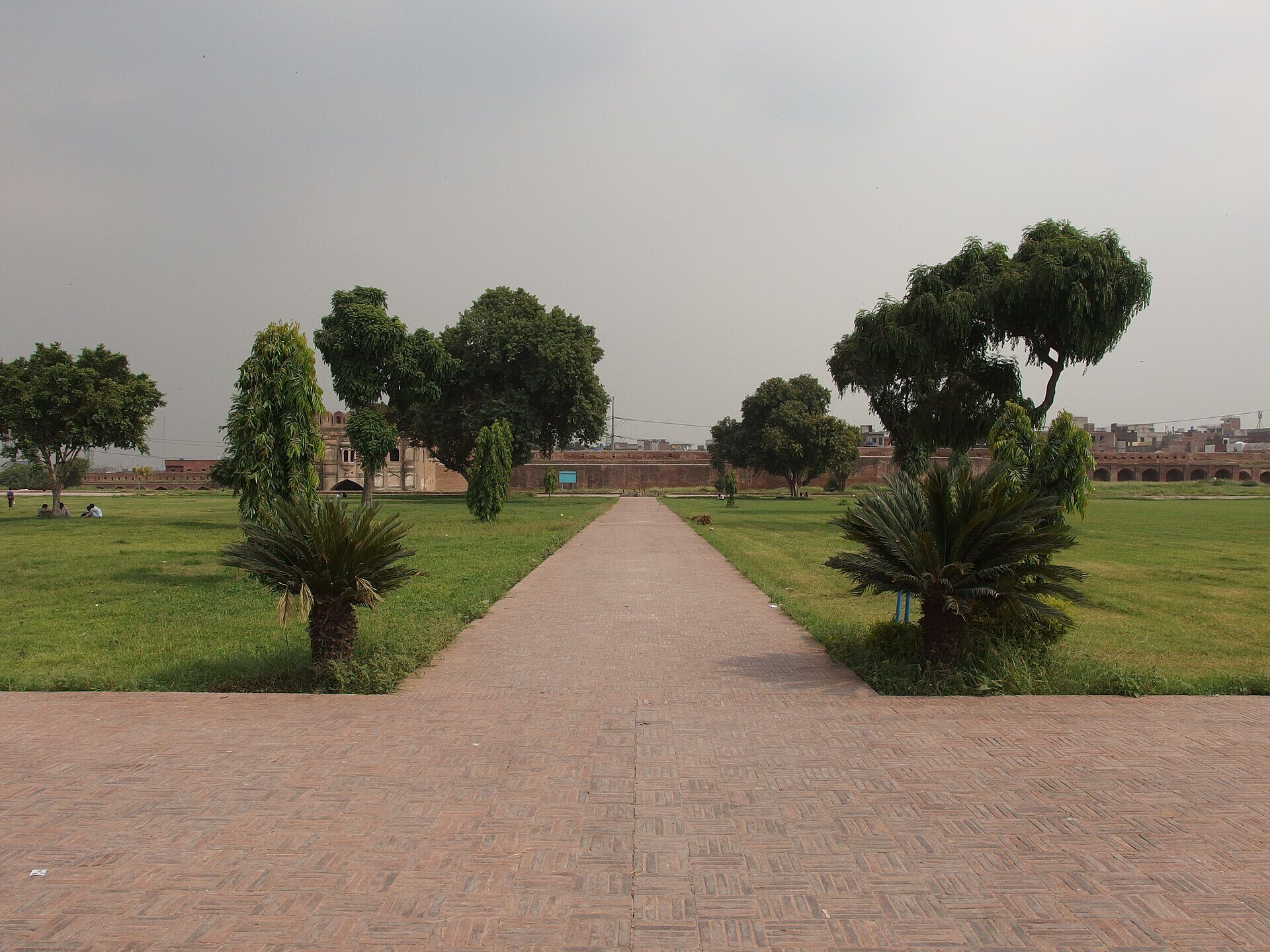
The Sheesh Mahal — Palace of Mirrors
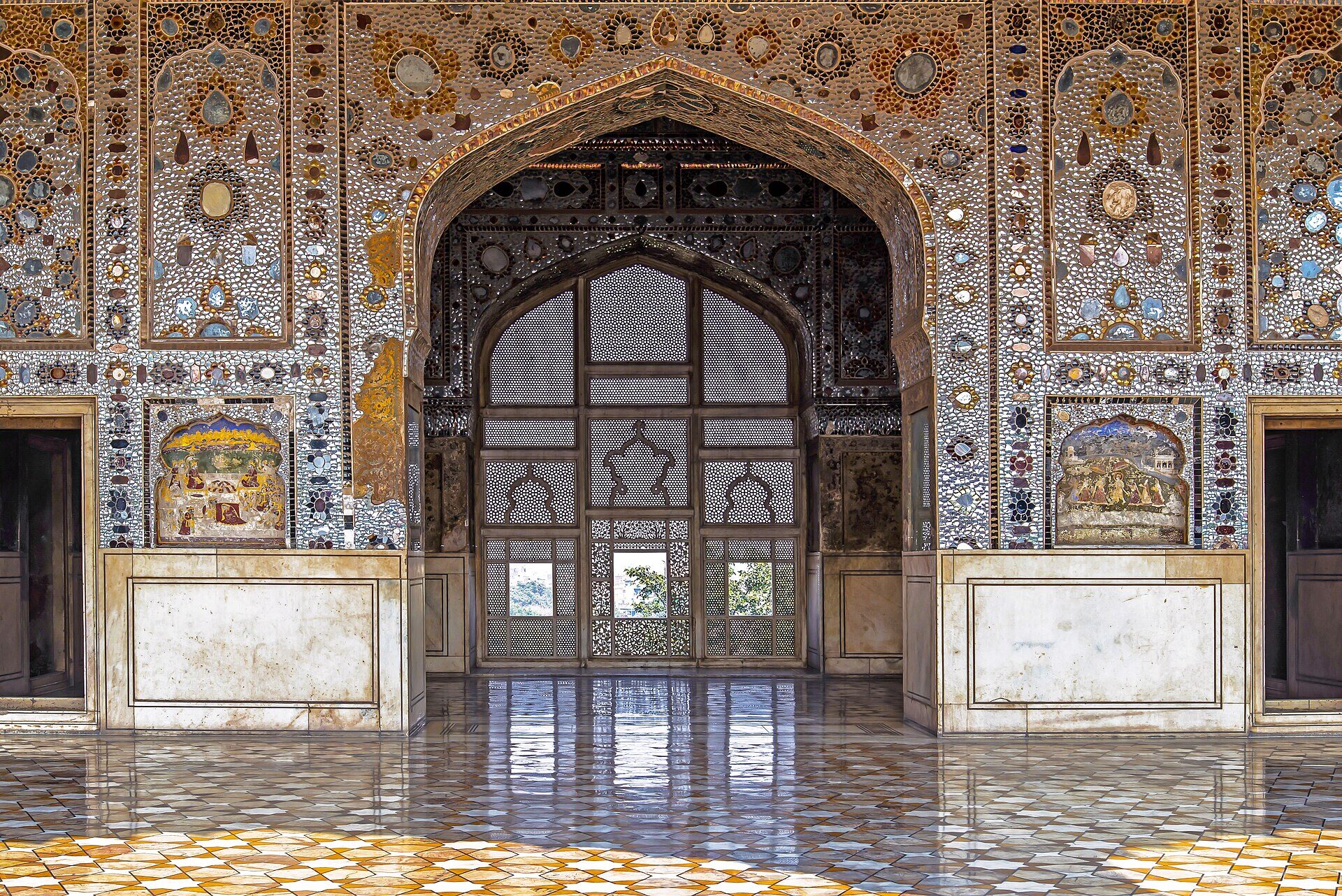
The Sheesh Mahal (Palace of Mirrors) is without question the most celebrated interior in Lahore Fort, and one of the most dazzling architectural achievements of the Mughal world. Built by Emperor Shah Jahan in 1631, the palace takes its name from the thousands of tiny convex mirrors set into its ceilings and walls in geometric patterns, interspersed with painted floral motifs in gold and vivid colour. When illuminated, as it would have been by oil lamps in the 17th century, the effect is of standing inside a glittering celestial vault, every surface reflecting and multiplying a single flame into an infinite constellation of light.
Today the Sheesh Mahal is partially restored and remarkably well-preserved. The inlay work on the walls combines mirror glass, coloured tile, gilded plasterwork and semi-precious stone in a density of ornament that rewards close examination. Allow at least 30 minutes here, the chamber changes character depending on the angle of light and where you position yourself. Late afternoon, when sunlight enters at a low angle through the arched openings, produces the most spectacular effect.
Alamgiri Gate — The Ceremonial Entrance
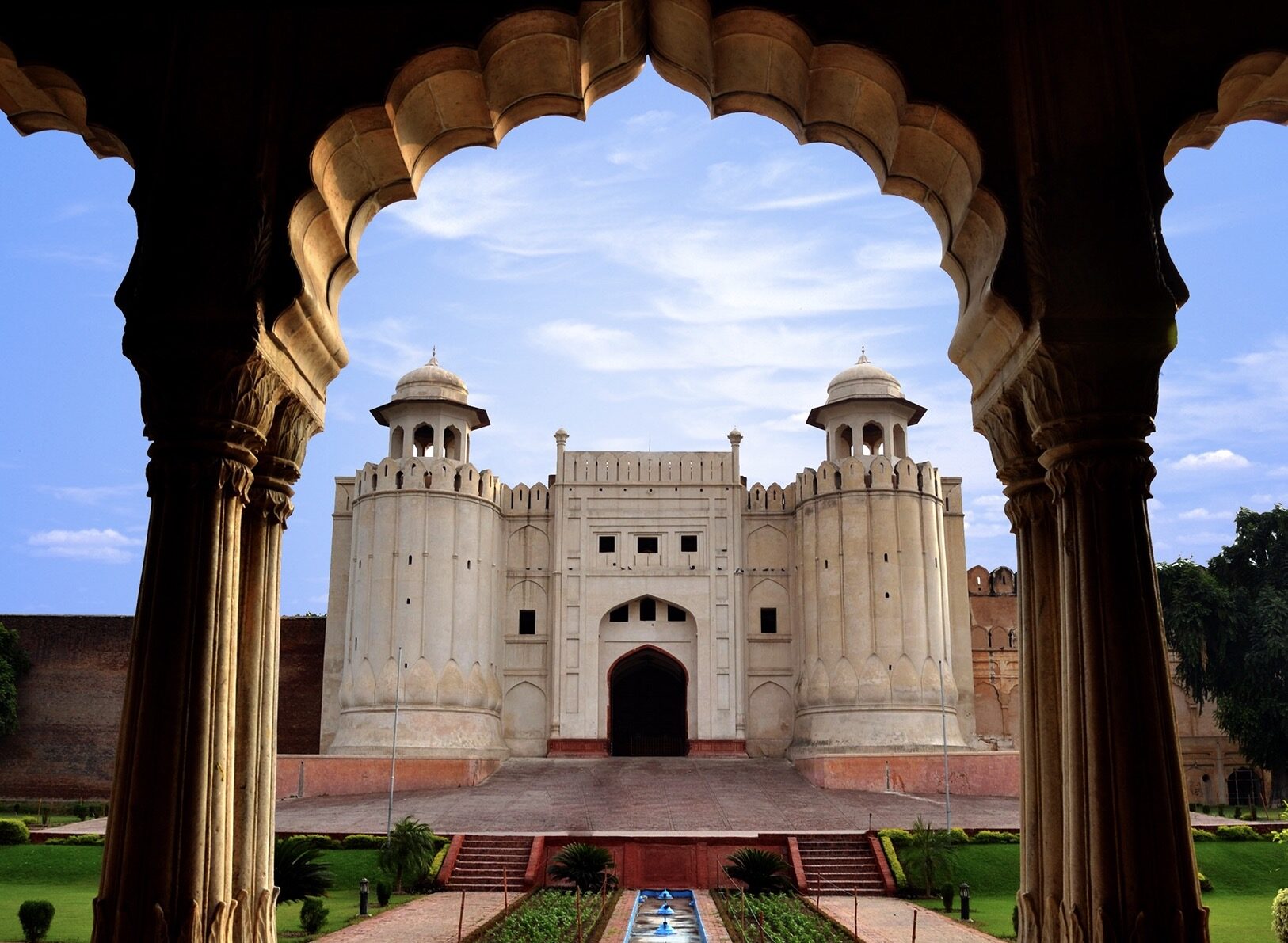
The Alamgiri Gate, built by Emperor Aurangzeb in 1673, is the fort's main ceremonial entrance and one of the top examples of late Mughal gateway architecture. Its semi-circular bastions topped with marble chattris (kiosks), its arched recesses decorated with carved floral panels, and its massive central portal all combine to create a composition of controlled grandeur that announces the approach to the royal complex. The gate faces the Hazuri Bagh garden and the Badshahi Mosque directly opposite, a deliberate alignment that makes the view from the Alamgiri Gate entrance one of the great urban vistas of South Asia.
The Diwan-i-Aam and Diwan-i-Khas
Emperor Shah Jahan built both the Diwan-i-Aam (Hall of Public Audience) and the Diwan-i-Khas (Hall of Private Audience) in the 1630s. The Diwan-i-Aam, a vast colonnaded hall where the emperor received petitions from ordinary subjects, demonstrates the Mughal genius for theatrical space: the emperor would appear elevated on a marble throne platform visible from the entire hall, rendering governance a form of spectacle as much as administration. Generally, the Diwan-i-Khas, smaller and more intimate, was reserved for encounters with nobility and foreign dignitaries. Both halls showcase the Mughal technique of combining red sandstone and white marble inlay in geometric and floral patterns.
Moti Masjid and Shah Burj
Within the fort complex, the small Moti Masjid (Pearl Mosque), also built by Shah Jahan, is an exquisite exercise in pure white marble that creates a striking contrast to the red sandstone architecture surrounding it. Its three domes, delicate marble lattice screens and meticulous proportions make it one of the most serene spaces in the entire fort. The Shah Burj (Royal Tower), added by Emperor Jahangir and subsequently embellished by Shah Jahan, offers the best elevated views over the Walled City of Lahore and across to the Badshahi Mosque.
Practical Information
Also, the fort is best explored with a guide or audio guide. Moreover, the historical and architectural significance of many areas is easily missed without context. Official guides are available at the main entrance for PKR 500–1,000 for a two-hour tour. Audio guides cost PKR 200 and are available in English, Urdu and several other languages. The fort grounds are extensive and involve considerable walking on uneven historic surfaces, wear comfortable, flat shoes. Besides, the site is not air-conditioned and Lahore's summer heat (May–August) can be severe. Morning visits are a good idea during these months. Water is available inside but bring your own to be safe.
Lahore Fort tickets and prices
Here is what a visit to Lahore Fort costs. Prices are per person unless noted. Because they change with the season, treat them as a guide.
| Ticket Type | Price | Notes |
|---|---|---|
| Pakistani Nationals — Adult | PKR 500 | ≈ USD 1.80 |
| Foreign Visitors — Adult | PKR 1,000 | ≈ USD 3.50 |
| Children (under 5) | Free | All nationalities |
| Audio Guide | PKR 200 | English, Urdu + others |
| Official Guide (2 hours) | PKR 500–1,000 | Negotiable; recommended |
| Method | From | Cost | Time |
|---|---|---|---|
| Ride-hailing (InDrive/Careem) | Lahore Cantt / Mall Road | PKR 200–400 | 15–25 min |
| Rickshaw | Walled City area | PKR 100–200 | 10–15 min |
| Lahore Metro Bus | Shahdara terminus | PKR 30 | 30–40 min |
| Taxi | Anywhere in Lahore | PKR 300–600 | Varies by traffic |
Lahore Fort opening hours
| Day | Hours |
|---|---|
| Monday – Sunday | 8:00 AM – 5:00 PM |
| Last Entry | 4:30 PM |
| Ramadan | Hours may vary — confirm locally |
Hours shift on public holidays. Check the official website on the day you go.
Best time to visit Lahore Fort
The best time to visit Lahore Fort is November to March. April and October also work well if your dates are fixed. If you can, avoid June to August.
- Jan
- Feb
- Mar
- Apr
- May
- Jun
- Jul
- Aug
- Sep
- Oct
- Nov
- Dec
BestGoodFairAvoid
Tips for visiting Lahore Fort
These tips make a visit to Lahore Fort easier, especially if it is your first time.
Visit in the Morning
The fort opens at 8 AM and the first two hours are dramatically quieter. Soft morning light on the red sandstone is also exceptionally beautiful.
Hire an Official Guide
The fort's historical depth is difficult to appreciate without context. Official guides dramatically improve the experience for first-time visitors.
Best Photography Spot
The view from the Shah Burj tower, overlooking the Badshahi Mosque and the Walled City, is one of the top photographs you can take in Pakistan.
Wear Flat, Comfortable Shoes
Also, the fort involves extensive walking on uneven historic brick and stone surfaces. Heels are impractical and potentially dangerous on the older staircases.
Carry Water and Sunscreen
The fort grounds have limited shade. In fact, in October–April, sunscreen and a hat are advisable. In summer, a morning visit before 10 AM is essential.
Combine with Badshahi Mosque
The Badshahi Mosque is directly opposite the Alamgiri Gate, a 2-minute walk. Combining both makes a perfect half-day itinerary of Mughal Lahore.
Lahore Fort: frequently asked questions
How much does it cost to visit Lahore Fort?
Entry to Lahore Fort is PKR 500 for Pakistani nationals and PKR 1,000 for foreign visitors (about USD 3.50). Children under 5 enter free. Audio guide rental is PKR 200 additional.
What are the opening hours of Lahore Fort?
Lahore Fort is open daily from 8:00 AM to 5:00 PM. Last entry is at 4:30 PM. The fort closes earlier during Ramadan. Verify directly before visiting.
Is Lahore Fort a UNESCO World Heritage Site?
Yes, Lahore Fort was inscribed on the UNESCO World Heritage List in 1981, together with the nearby Shalimar Gardens, as an outstanding example of Mughal civilisation at its peak.
How long does it take to visit Lahore Fort?
Allow 2.5 to 4 hours to explore Lahore Fort properly. Moreover, the fort contains 21 notable monuments across a large walled complex. A rushed visit covering highlights takes a minimum of 90 minutes.
When is the best time to visit Lahore Fort?
The best time to visit Lahore Fort is November to March. April and October also work well if your dates are fixed. If you can, avoid June to August.
Updated October 2026. Prices and opening hours change, so check the official website or the official Pakistan tourism site before you travel. Spotted a mistake? Tell us and we will fix it.
Photos: Rohaan Bhatti / CC BY-SA 3.0 via Wikimedia Commons; Faisalrazamalik / CC BY-SA 4.0 via Wikimedia Commons; King Eliot / CC BY-SA 4.0 via Wikimedia Commons; Guilhem Vellut from Annecy, France / CC BY 2.0 via Wikimedia Commons.